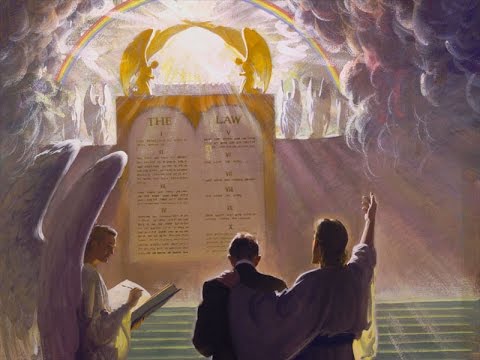
These two chapters lift the veil from heaven so we can see first hand what is happening there. When an angelic voice calls John and places him in his prophetic trance, he finds himself in a throne room at the time of Jesus’ ascension. The prophet describes incredibly magnificent cosmic phenomena and wondrously strange creatures that delight the ear but are impossible to visualize. Good scholars tell us not to waste our time trying to identify the creatures, because after long study even they can only make wild guesses. Instead we should ask what John is trying to express. His two most obvious intentions are to proclaim that God controls the world and that he governs nonviolently.
The throne room is filled with heavenly choruses singing praise to God who significantly sits silently on the throne. It is a critical time in the salvation of the world, because God needs someone worthy to initiate the final stages of salvation. Just when people begin to despair, a cry goes up, “The Lion of Judah”, a military title that would indicate a victorious general like King David. When people swerve to see this magnificent messiah now ascended into heaven, they witness a slaughtered lamb. The hallelujah chorus breaks out again, this time praising not only God but also the Lamb. It begins with the strange living creatures and elders around the throne, then myriads of angels, and eventually every creature in heaven and earth.
From this point, John predominantly uses the Lamb to symbolize Christ. Each of the 30 times, John chooses a Hebrew word emphasizing vulnerability. At times, the word picture of the Lamb might sound military, but the sword is always his tongue and the blood on his robes is his own. He never fights, because he has already won the key battle on the cross. We shall find the only weapons allowed his followers are the Word of God, prayer, and the sacrifice of their lives.
Scholars do help at this point by reporting that the heavenly liturgy is obviously based on imperial court ceremony that the people of John’s seven churches would have witnessed when the emperor visited their cities. Authorities would welcome him by gathering around in concentric circles according to rank. Large choruses would sing his praises, using virtually the same words, such as “Worthy art thou!” People would address him with titles such as god, son of god, god manifest, lord, savior, epiphany, and imperator. They would prostrate themselves before him, even laying down their crowns as signs of their loyalty. Various pyrotechnics would be employed to highlight his splendor.
All the while, the Caesar, often holding a scroll, would remain silent as people presented their petitions. Just as the angels presented bowls of prayers to our silent God, so, too, the imperial officials would receive petitions from his subjects that the emperor would consider later. The entire ceremony was to demonstrate that the Pax Romana promised eternal peace, justice, and order.
When John lifts the veil from heaven, it is not the mighty Roman Emperor who sits on the throne controlling the world, but our God. Like the emperor, he remains silent, letting all that he created speak for him. At the Ascension, they are joined by Christ the Lamb. The prophet is attempting to proclaim that the emperor’s rule is based on military power and our God’s reign on caring love. He promises, in the end, God will speak as he wipes away the tears of those who have suffered under Rome, comforting them with “I make everything new.” In the meantime, we are to confess “Christ is Lord,” never “Caesar is Lord.”