Any decent understanding of Paul’s letters begins with an appreciation that they were written to particular congregations in a specific historical period. They were preserved in scripture, because the apostle handled their problems in a manner that remains relevant for us.
So, too, any meaningful interpretation of Revelation depends on discerning the situation John was addressing. And in the prophet’s case, it is far easier, because he clearly lays out what is going on in the seven churches to whom his letter is written.
I can imagine some readers shaking their heads and thinking, “Come on! There is nothing clearly laid out in this strange epistle.” However, I insist it is pretty evident, if you don’t allow yourself to get bogged down in the colorful apocalyptic word pictures. Remember,
these are exactly that, auditory stimulants that incite the imagination. They cannot be understood rationally nor transposed into visual drawings. Often while you are still reeling, the angel will explain all that you need to know. At other times, there will be a strange allusion to familiar biblical passages. Scholars chart over 500 biblical references that are never specifically noted, most of them from Ezekiel, Daniel, and Exodus.
The most important of these word pictures are those that are very consciously repeated throughout the letter. Foremost of those are Jesus pictured with a sword coming out of his mouth and even more, Jesus as the Lamb of God. If you miss these, you miss John’s understanding of the Gospel that calls for nonviolence in a violent world. How incredible that so many dismiss the book for being too violent.
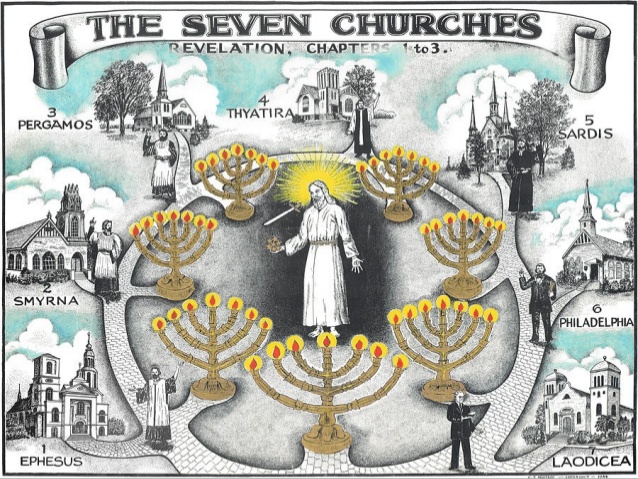
So what do we learn about these seven churches? They are congregations that Paul started 50 years ago in Eastern Asia Minor. They are presently experiencing persecution of various kinds from Roman provincial authorities and neighboring Jewish synagogues, as well as conflict within their own communities. Even a casual reading of the two chapters reveals this.
Scholars point out that persecution did not mean that Rome was rounding up and killing every Christian they could identify for 300 years. For the most part, the emperors realized too much violence was self-defeating. They wanted to create a situation in which those outside the Church were afraid to join and those inside began leaving. They could do this by executing or exiling a few outspoken leaders. Although only Antipas is named as a martyr in this letter, there is other evidence that 3 of the 7 congregations remembered members who gave their lives for their faith.. The historian Eusebius recorded that Bishop Polycarp, who lived 60 years later, was the 12th martyr from that region. Of course, John himself was removed to the island of Patmos.
Significantly, John links the political persecution to emperor worship. Augustus began a trend that encouraged citizens to praise divine characteristics of the Caesars. In the West, this amounted to little more than a pledge of allegiance. In the East where our seven congregations are located, it took worship forms. Three of John’s seven cities had temples dedicated to Caesar, one of which he called the throne of Satan. Throughout his letter, the apostle focuses on contemporary myths that developed after Nero committed suicide in 68 AD. He had unabashedly declared himself divine and was remembered for unmercifully executing Christians.
Other emperors were far more subtle. Check out the comment I attached to the lesson. It contains letters between the governor Pliny and the emperor Trajan concerning how to test Christians. Those accused were asked to curse Christ and burn incense before a statue of the emperor. If they were willing to do this, they were released, even though suspicion might remain that they were faking it. The shame of publicly denying their faith achieved Rome’s goal perhaps even better than execution.