Try as hard as I might, I find I cannot let go of this rather disjointed investigation of truth. Every time I think I find a way out, another unanswered question disturbs me. My intention was to slip away with a lesson on truth and irony, perhaps beginning with E. C. Bentley’s “Between what matters and what seems to matter, how should the world we know judge wisely?” I would move on then to consider Nils Dahl’s observation that the Gospel account of the Passion is filled with irony as Roman soldiers and the governor proclaim Jesus to be the Christ unwittingly, suggesting this reflects in good measure our own confessions. My conclusion would then offer a caution that we do well to be humble, especially refraining from ad hominem arguments, as we each acknowledge our own twisting of the truth to our own advantage.
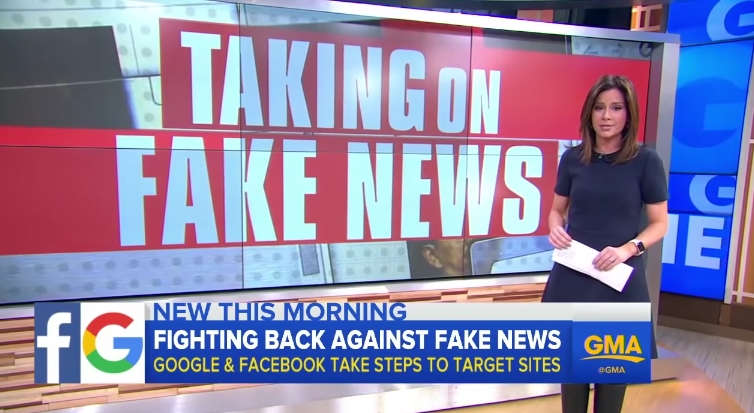
Suddenly, another question emerged, one that I have been dancing around, the one I think gets to the bottom of fake news and alternative truth. The study began somewhat with the question of how our nation could elect a candidate who openly based his campaign on “enhanced truth.” The focus at that time was on Donald Trump. Now after over a dozen lessons, I at least find the focus on the nation, about what this situation says about our society, about us– not Trump.
Admittedly, this question like all the rest in the study was motivated by the news of the current week. The media reported Obama has accepted two deals in which he will receive almost half a million dollars for a few hours work. Suddenly, things began to make sense.
Previously, I could not understand how anyone, especially an overwhelming number of Christians, would vote for a person who, by any moral or biblical standards, is an indecent human being. No one seemed to disagree with that assessment of his character. They simply claimed that the other candidate was just as or even more indecent.
Previously, I thought those who felt they could not in good conscience vote for either candidate were stupid. Voting for the Green Party, because it represented their true values, enabled a person without any principles to assume power over us. Now, I wonder if there does not come a time to vote on your real values.
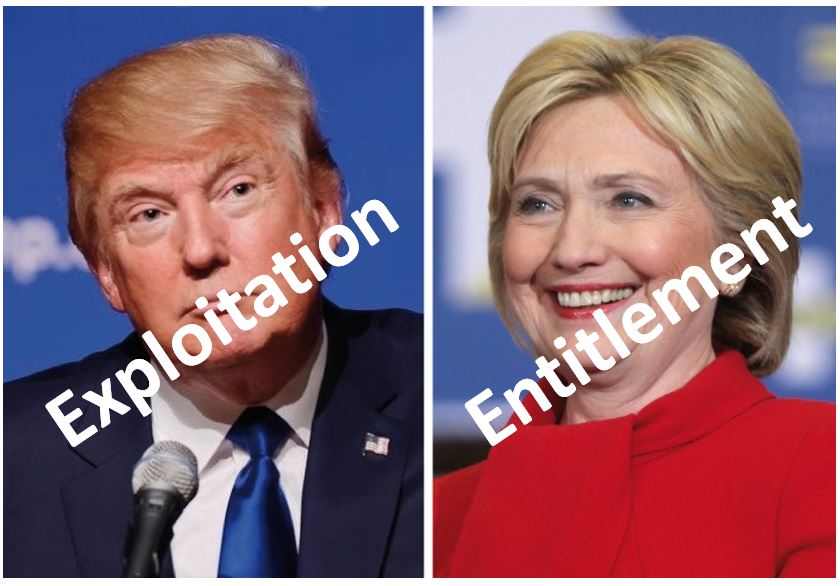
Previously, all of my friends (No! No! No!….all of my friends and I) agreed that the election was pitting exploitation against entitlement, but felt the exploitation on the other side was far, far more immoral than the entitlement on our side. Now, I am beginning to see that entitlement is also obscene and reflects, in many ways, the same lack of values.
The common denominator is obviously greed. We speak of money controlling our government. I think the election reveals the love of money is controlling our whole society. It prevents us from seeing the truth, especially as it pertains to us. The issue is no longer radical individualism but egomania; no longer pretending regard for the common good but openly replacing that with self-aggrandizement.
A few weeks ago, Kerry offered a marvelous critique of Ron Deher’s book, claiming in part that he is obsessed with sexual issues far more than scripture and tradition warrant. If we answer Bentley’s question by using scripture and tradition, we do find much about greed. In fact, the Gospel narrative speaks right at the present situation. Jesus warns against the values of the Sadducees and Pharisees. He describes the former as exploiters of the people who think they can maintain their relationship with God by observing only the ritual law while making deals with the Roman occupiers. He has even more to say about the Pharisees who believe they are entitled to God’s favor, because they are truly moral people. Their danger is looking down their noses at the deplorables with whom Jesus shared his meals.
In the coming weeks, I will look at how, if read intelligently, John’s Revelation first, offers a way to balance Paul’s understanding of government and second, how the scriptures and tradition chart a decent way to use money.