It’s easy to see John is talking about meaning rather than events. He moves from the raising of Lazarus to Palm Sunday to Holy Thursday skipping all the events recorded by the other gospels. Then he spends almost a fifth of his book with conversation at the Last Supper.
He gives us a clue to his purpose when right off he has the High Priest say it is necessary for one person to die in order to save the whole nation (John 11: 45-54) and then repeats this in the middle of the Passion Story (John 18: 12-14). Of course, the priest means it as a utilitarian political statement. With eyes of faith, we should see its deeper ironic and theological meaning.
John is trying to answer questions, such as, “What do we mean when we say Jesus dies for our sin?” “What is going on when the Messiah, who is supposedly the victorious king and general who overcomes the forces of evil, is executed in defeat by those forces?”, and “What kind of God sacrifices his son when one of his primary claims in the past was that child sacrifice is an abomination?”
John offers three usually overlooked answers in his Last Supper conversation(John 13: 1-35, 15: 12-17). First, he makes clear Jesus is God. He has been preparing us from the beginning of his gospel, repeatedly having Jesus make “I AM” statements. Now in his passion story, Jesus is always saying “I AM,” e.g. after the foot washing and at the arrest.
If we still do not get it, he says to the point of boredom that he and the Father are one, e.g. in John 14: 8-12. In our time when people no longer hear the proclamation in terms of the Trinity, I think it is important to stop proclaiming “God gave his son for us.” We do better to make clear “God gave himself for us,” following Paul’s formula in II Corinthians 5:9, “God was in Christ reconciling the world to himself.“ In John to speak of Jesus’ Passion is to speak of God’s Passion.
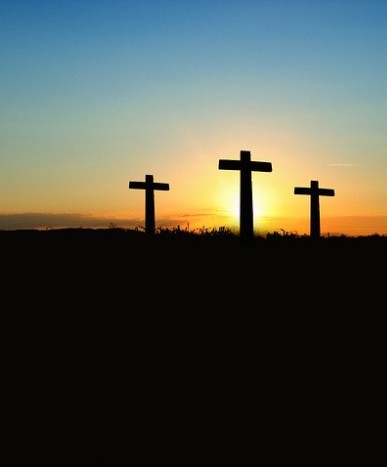
John’s focus from beginning to end is on what God does, not our sin. The Cross is not about the punishment we deserve, but on what God is doing to rescue us from Evil that obviously includes our own self-destructive actions.
Second, John makes clear on the Cross God is serving and loving us as he acts like a good friend who gives his life for us. Jesus washes his disciples’ feet to show this is God serving us. His Love Commandment makes clear this is God loving his world. After claiming God regards us as his friends, he acts as such by giving his life for us. Like the Good Shepherd, God gives himself up to the Wolf to protect his sheep. There is nothing here about substituting himself for our punishment. God dies to protect us from Evil.
Third, the purpose of all this is to transform us. John’s New Commandment in 13: 31-35 and 15: 12-17 is quite different from “Love God and your neighbor as yourself.” John puts it “Love one another as I have loved you.” All begins with God; all begins with grace. He returns good for our evil, so we in turn can return good for evil in our corrupted world. We are transformed so we are ready to lay down our lives for our friends.
Christ dying for our sins must be seen in the context of the Covenant that began with Abraham. God blesses us, so we bless until all are blessed. The main focus is not on entering some kind of heaven after we die, but rather on participation in saving the Creation now. John is all about love. The Cross is all about unconditional Love overcoming all resistance.