
Martin Luther defined the relationship between church and state with a two kingdom doctrine. The standard of the Church is love as she inspires people by proclaiming the Gospel. The norm of the government is justice as it defends people from evil. Although many scholars believe this led to a separation of powers that enabled Hitler to brutalize without opposition, it is better read as a 16th century development of the just war theory.
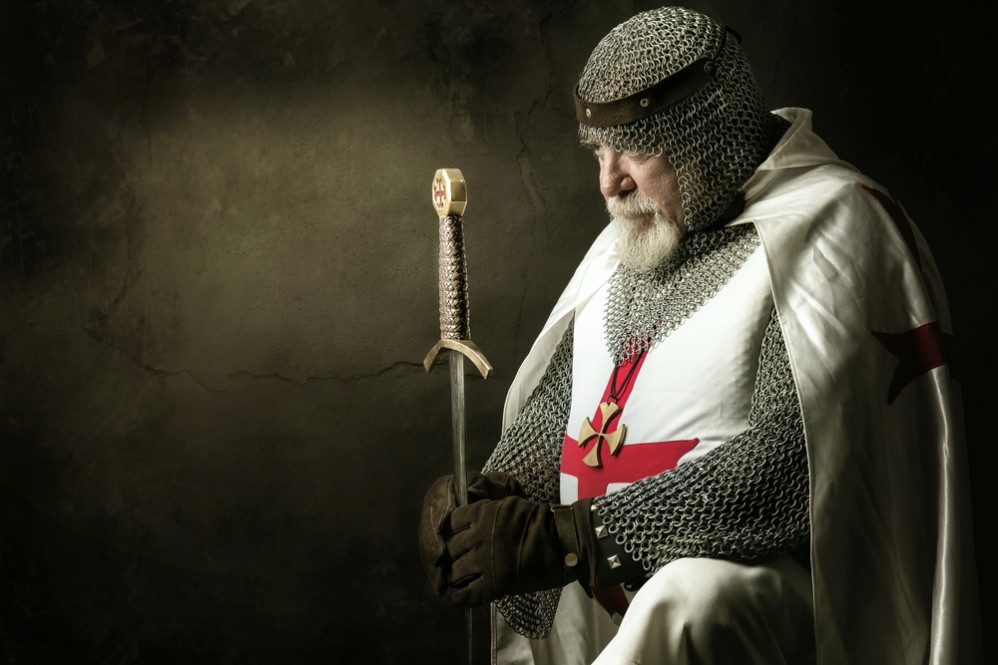
After Constantine legitimized the Church in the 300s, Christians had to take responsibility for governing. This led them to modify their former teaching of unconditional pacifism. St. Augustine introduced a theory of just war based on a lesser of two evils approach. He argued believers had to seek acceptable principles for engaging in self-defense and countering greater evils. This must be done with a sad and mournful spirit that resorts to violence only because of human nature’s dark side. You get an idea of Augustine’s perspective, if you remember he was the theologian who developed the doctrine of original sin.
The Church expected the government to abide by this concept of what served as justice in warfare. Her prestige forced governments to accept the theory, even though they might never have fully practiced its principles. For many centuries Christians at least had a basis from which to confront war practices. All of that is pretty much gone today when the Church has lost her prestige and many scholars argue just war is no longer relevant.
That accounts for so few people even knowing there is such a theory. I was amazed early in my ministry when no one in a very sophisticated Sunday School class except a retired army officer could list any of the classic principles. I thought it was significant that he knew them all.
As I list them, ponder if you think Christians should still expect their governments to observe the tenets. A greatly summarized account would go something like this: In order to engage in war one must have 1) a just cause, such as self defense or overcoming a great evil, 2) right authority, meaning a recognized government must make a declaration of war, 3) right intention that includes setting forth the actual objectives and these should include restoring peace, 4) overall proportionality that insists the good to be accomplished must be greater than the cost of overcoming the evil that exists. One should not enter a war if the good one hopes to achieve is outweighed by the destruction of human life and moral values which it inflicts, 5) a reasonable hope of success, 6) a situation of last resort, 7) a goal of restoring peace, and 8) appropriate combat that uses discrimination to avoid harm to noncombatants and proportionality that only uses weapons and force sufficient to overcome the enemy. It is assumes that there will be no attacks on hospitals or schools, no looting or rape, and no atrocities.
The theory has been challenged as all nations have adopted terrorism as part of modern war strategy. This strategy more than the nature of modern weapons has led to civilians accounting for half of the deaths from war in each century since 1700s. Civilians’ deaths were 800,000 in 1500s and 53.9 million in 1900s. Our nation has participated in fire bombing cities as well as napalming troops and villages. Ours is the only one that has dropped not one but two nuclear bombs.
The question for Christians becomes if we can expect our governments to abide by any kind of justice when engaging in war. If so, what would those principles be in our day? If not, must we return to advocating pacifism as the Christian position?