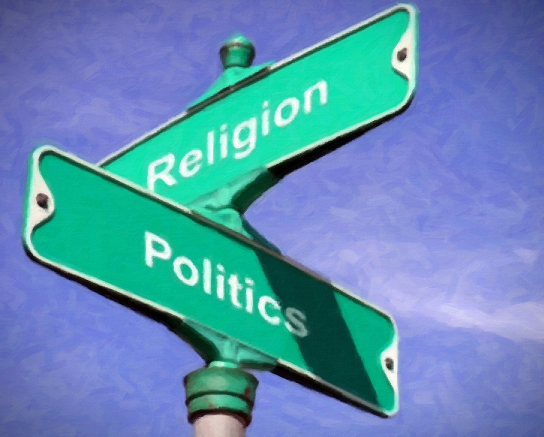
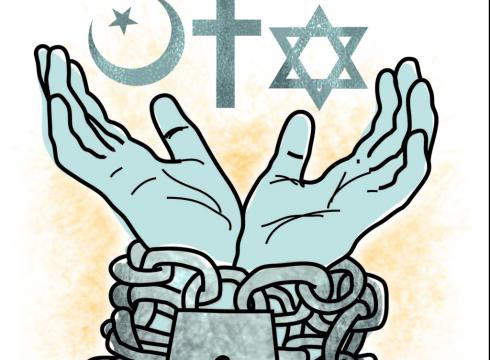
I think the widely ignored freedom of religion movement indicates the problem Christianity faces in a modern democracy. People in my circles thought the advocates were a paranoid minority of various church bodies. Now those paranoids control our government.
Let me chart what I think developed in my lifetime. When I entered the ministry, pastors felt they had to keep politics out of the pulpit. After all, the 1954 Johnson Amendment threatened to remove tax exemption if they directly or indirectly supported or opposed any political candidates. Consequently, most of us in 1960 felt John F. Kennedy could separate his politics from his Roman Catholicism.
Then the Viet Nam war challenged all this. Conservatives warned those of us who opposed the war that we were breaking down the separation of church and state. They were worried the government might force churches to pay taxes, stop pastors from acting as state officials when they married people, and include pastors in the military draft. Some of us wondered if that might free us to proclaim the full Gospel.
Things reversed around 1979 when conservatives such as Jerry Falwell with the Moral Majority accused politicians of destroying Christian family values, defining these as opposing abortion and homosexuality and supporting a strong defense budget. These Evangelicals advocated taking political action, beginning by getting elected to local school boards.
In 1994, the Evangelicals were joined by Catholics in issuing the statement “Together: The Christian Mission in the Third Millennium.” It was pretty much overlooked, because the signers acted as individuals rather than officials of their churches. The statement recognized a common mission it defined as defending the religious freedom necessary for the right ordering of civil society. It warned that some Muslims and secularists had motivated our courts to to narrow the protection of free speech and to penalize and marginalize churches. Although it mentioned support for parochial schools, the market economy, and Western culture, most readers came away thinking it was designed to oppose abortion. Its only specific call to action was seeking legal protection for the unborn. Pertinent to our lesson was the claim, “wherever government goes religion must retreat, and government increasingly goes almost everywhere.”
In 2009, the Orthodox were added to a very similar document commonly known as the Manhattan Declaration. It picked up the idea of a culture of death threatening the sanctity of life by offering abortion on demand, accepting same sex weddings, and using coercion to force citizens to compromise their deepest convictions. Notice the group now goes much further in accusing the government of attacking churches and with that, the fundamental principles of justice and common good. Consequently, the signers pledged they would not comply with some duly enacted laws. It is now the conservatives who resist the government.
In 2010, the Obama administration tried to restore a private understanding of religion by using freedom of worship rather than freedom of religion in its communications. Part of Donald Trump’s success has been taking the other side. His 2018 White House Faith and Opportunity Initiative assured conservative Christians he would promote every point of their agenda. Quite frankly, many on both sides had already flagrantly broken the Johnson Amendment by welcoming presidential candidates to speak in their services.
Even this quick look reveals we have entered a new stage unforeseen by our founding fathers. Their main intent in the First Amendment was obviously protecting free speech that they felt would be promoted by prohibiting the establishment of any one religion. I do not think they ever imagined church bodies uniting for political action in ways closely resembling an established religion. The statements themselves assert the need to do this, because of the problems presented not only by secularists but also non-Western cultures and religions.
I also wonder if our forefathers imagined that the Bill of Rights would be used to discriminate against the minorities it was meant to protect. That is certainly what seems to be happening when free expression of religion is allowed to deny rights to the LGBTQ community. However, an even deeper problem has emerged as modern society assumes the pursuit of happiness includes access to the benefits of modern technology. In some circles, the free expression of religion includes denial of birth control, abortion, scientific research, and such. This clearly prevents some individuals from the right to obtain things that they regard as their pursuit of happiness. Let’s look at this one next week.