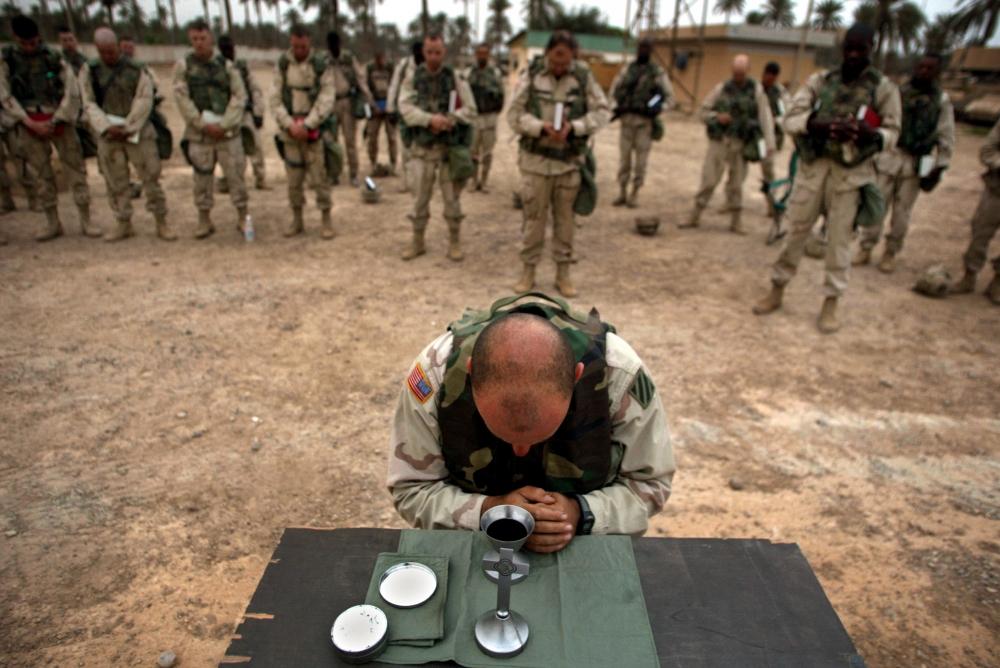
Lupe suggested we have to redefine sin in our time. That is at the back of many of the youth’s discussions. They charge the adult world of ignoring or denying what is going on and so failing to provide ethical insight. A good example is war and peace. The adult society acts as if we still have guidelines for “just war”. However, it takes little thought to realize drone bombings in nations with whom we have not declared war, the killing of civilians as “collateral damage”, and invading a country under false pretenses does not fit traditional “just war” theory. The young people in our groups might not represent all youth culture, but they have profound questions about our present military actions. That does not mean they necessarily oppose them, but they certainly believe our leaders have not supported them with ethical arguments. I sent them the following notes as a basis for discussion after the Young Adults noted an air strike placed us in a fourth “war” right after our leaders publicly promised to remove troops from other theaters. I had used somewhat the same notes when the high school group wanted to discuss Christian positions on war.
I. There have been three classical Christian responses to war:
A. Pacifism. For the first 300 years Christians refused to shed blood. Jesus told us to love our enemies and turn the other cheek. He came as the Prince of Peace on Palm Sunday and told Pilate he would not use force to bring his Kingdom. The first Christians followed his lead, trying to return good for evil. Of course, they could depend on the Roman army for protection.
B. Just War. After Emperor Constantine legitimized the faith, Christians had to take responsibility for protecting society. St. Augustine developed a just war theory which claimed Christians could participate in war if 1) there was a just cause such as self defense, 2) it was declared by a legitimate authority such as a recognized government, 3) it was based on a right intention such as the goal of restoring peace, 4) care was taken to make sure more good than evil resulted, 5) there was a reasonable hope for success, and 6) only proper weapons were used and never against civilians.
C. Crusades. During the Middle Ages Christians championed crusades as a form of holy war against pagans. Although these have been an embarrassment to most Christians, George Bush initially spoke of the Iraq War as a crusade against the “axis of evil” and some right wing Christians speak of war in the Holy Land as necessary for bringing the Kingdom of God.
II. Christians are currently asking what our position should be in the modern situation.
A. Christians have practiced some form of just war theory most of our history. During the Revolutionary War a Lutheran pastor, Peter Muhlenberg, removed his robes to reveal an officer’s uniform and then led his congregation to battle. Lutheran churches in Gettysburg ministered to the wounded of North and South, although some of our leaders spoke against slavery. Just War worked during the 19th century which was rather peaceful. The World Court at The Hague was established to settle disputes without armed conflict. At the beginning of the 20th century churches believed we might have the moral force to end war forever.
B. However, the violent wars of that century have led many to question if Just War is still realistic. Terror has become a strategy. Governments bomb civilians to scare the population. Consider there was only one civilian death in the Battle of Gettysburg and people estimate there were 53.9 million civilian deaths from 20th century wars. Small illegitimate groups also use the power of technology to challenge huge powers. In fact, this great power prompts many to ask if the cost of war in terms of human life and destruction can ever be justified by Christians.
C. This has led some Christians to think we must return to pacifism as the only reasonable Christian position. Lutherans traditionally have believed government’s role is to hold back evil, enabling our members to participate in legally declared wars. At the time of the Viet Nam draft the ELCA said Lutherans could consider themselves pacifists if they established a foundation for their beliefs, such as speaking with their pastors. Previously conscientious objection was pretty much confined to Peace Churches, such as Quakers and Mennonites. Now our government has extended this to Lutherans, allowing them to take noncombatant roles.