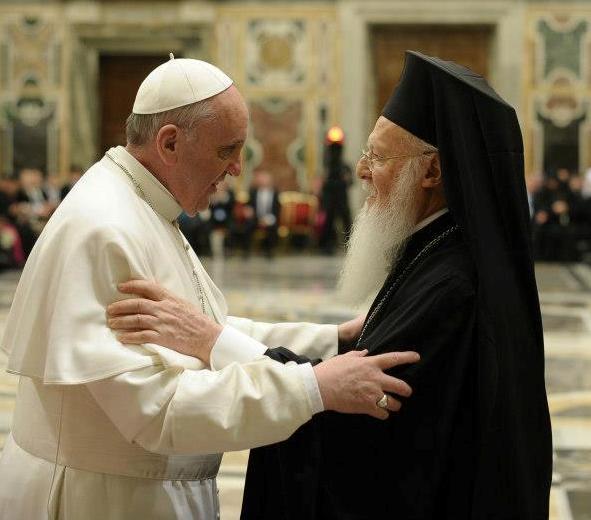

Several decades ago some writers observed progressives in all denominations are more comfortable with progressives in all other denominations than they are with conservatives in their own. Chances are this situation foreshadows what lies ahead for the American Church.
It also captures the sense of the comment Derek made last week. Although our church bodies continue to split, individual Christians are just happy to find each other in their professional and academic environments. Their joy comes from discovering others sharing the Christian lifestyle with integrity in spite of their organizational differences.
I think this is what is going to happen as seminary education changes. For simple financial reasons, most of our pastors will probably be trained in ecumenical seminaries in a hundred years. Right now, Lutherans cannot or are not willing to finance their seminaries. Because of this, we now have large physical campuses and faculties but very few candidates for the ministry.
The first response, which is happening to some extent already, is to consolidate seminaries and faculties. The next step is to train our leaders in ecumenical seminaries.
I can speak from experience about what will happen. When I attended an ecumenical seminary, I first found my identity by reading more Luther than my friends in Lutheran seminaries. But then I found my friends from other denominations were not as different as I had been told. When I studied, worshiped, and socialized with them for three years, I found we had much to teach each another. In fact, the experience caused me to question why our church bodies remained separated when working together would make a far better witness to our rapidly secularized society. I expect others will experience the same development at ecumenical seminaries and that this will lead to widespread questioning of our present church bodies.
Lutherans and other American Christians have heard this story for some time. In the mid-19th century, Samuel Simon Schmucker, the founder of Gettysburg College and Seminary, called for American denominations to join together for social work and missions and to wait for theological agreement to develop later. In the mid-20th century, Eugene Carson Bake essentially made the same proposal. This did lead to the forming of the UCC church, but others did follow suit. Perhaps by the mid-21st century, the suggestion will be finally implemented.
If this seems farfetched and at best a long way off, note that the present ELCA bishop of the Metro DC Synod and the Presiding Bishop of that Church were both trained at ecumenical seminaries.
Of course, this leads to some questions. Most of our readers yearn for the Holy Spirit. We believe we are called to discern and follow the lead of that Spirit in all we do and constantly pray that our churches would make their decisions based on this discernment. Now, we have to ask whether being forced by financial necessity to do something could be understood as following the Spirit. At the least, our leaders should acknowledge what is happening and begin to work creatively on a witness attractive for our modern society.