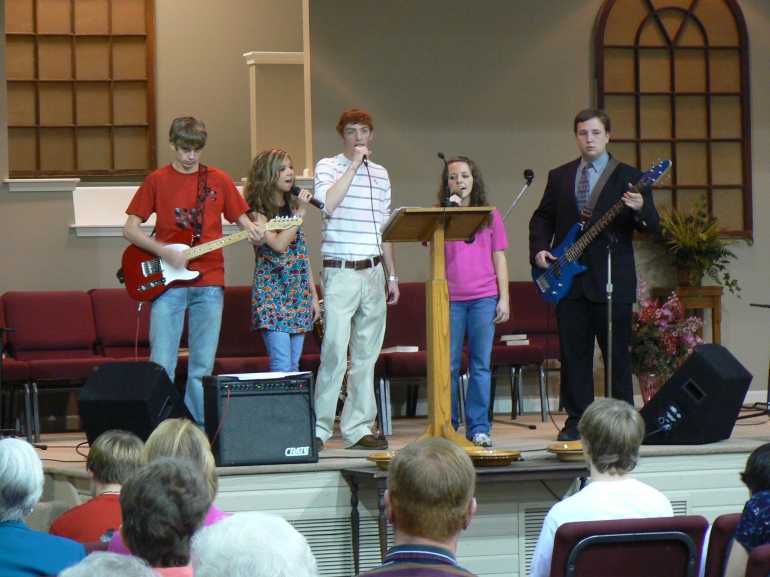
One of the big topics in church circles is whether we should use “contemporary” music and liturgies. My ministry was pretty old-fashioned in that area. However, my sons-in-law have both “contemporary” and traditional services, so I have had over a decade of observing both from the audience. That experience convinces me that we shall see more and more “modern” music. I prefer “modern” instead of “contemporary” to express music people are using rather than music from the past.
I myself listen to classical music most of the day, every day. However, I find I am a dinosaur. I especially understand that when I examine the arguments advanced for not using “modern” music, arguments usually made by those over 65.
The last argument to have any weight for me was that people do not participate, but rather become spectators at performances. It is true these do not rival the old hymn sings, but again the only ones who remember these are over 65. Lately I have noticed all sorts of marvelous participation: bodily movement, dancing with children, smiles, hand clapping, and much more emotional involvement. As for these being performances, we forget that, for centuries, the liturgy being championed by traditionalists was performed by a priest for a silent congregation.
Negative criticism also judges this modern music as “bad music,” claiming the church should always be using the best of every medium. When I suggest our primary mission is not cultural and “good” music is a matter of taste not quality, I am vehemently attacked, usually again by people over 65. I would still insist regardless of ones opinion about quality,
it is evident that the music is appreciated by younger people. Very few of them attend concerts of classical music, unless dragged by their grandparents. And the young people are found in modern liturgical services.
Another criticism questions the quality of the theology. “Good theology” is just as suspect as “good music” in our time. Scholars find theology is based on your experience. For example, my circle is pretty much Christianity as seen through German Lutheran eyes. That does not make it “good.” And quite frankly, old hymns are not known for their theology. Consider that a redundant theme in many Psalms is “Remember I am a good guy, Lord, and kill my enemies.”
It is true that the people’s liturgy sets standards just as canon and creed do. But that liturgy can be set to all kinds of music. My sons-in-law certainly do.
Regardless of this debate, I notice these “modern” services are the ones most new members and young families attend. This is especially obvious with African Americans and Latinos. I usually worship modern myself so I can be with children and grandchildren. And I enjoy the creativity I find. Lay people write new music, dance, and play their instruments.
I certainly hope the music of the future church will be “modern.” If we do not move in that direction, we shall be even more a church with aging congregations. We shall fulfill our mission of taking the Gospel to the nations when we appreciate what new members bring to us as well as what we offer them.