When I began my face-to-face classes by asking how many ethical decisions they had made that day, I received a variety of answers. Some felt these were confined to big questions that demanded carefully considering the proprieties and priorities of the options before taking action. Others believed just about all their acts involved some form of moral choice, usually based on “habits of the heart” rather than profound decision making.
When asked to define ethics, most talked about obeying the laws of the land or the Ten Commandments. Of course, ethics has always been associated in some way with law codes. Sometimes these were regarded as absolute, straight from the mouth of God; sometimes as natural law, built into the cosmos or based on the agreement of all reasonable “men.” This worked when people shared a common place and story. It is far more difficult in our pluralistic, mobile society. People no longer live their whole lives in one area, surrounded by neighbors who believe as they do.
Responding to this breakdown of traditional values, Sandel says moral reflection now involves a constant back and forth between personal judgments about the decisions before us and the general principles on which we base our lives, such as life, liberty, and the pursuit of happiness. Preferring to speak of ethical approaches, rather than theories or systems, he suggests three that are helpful: asking if the options maximize the welfare of society, respect the freedom of individuals, and promote virtue.
It is the third that incites the most discussion as people disagree on what kind of virtue society should be promoting. In the past, ethics always involved virtues that were qualities or traits beneficial for making proper moral decisions. Theologians often said their ethics were based on nurturing a virtuous or righteous person– righteousness defined as being in a right relationship with God and other people. They spoke of four cardinal virtues: courage, fortitude, temperance, and justice, that were available naturally to all people; but also three theological ones, faith, hope, and love, that were gifts from God.
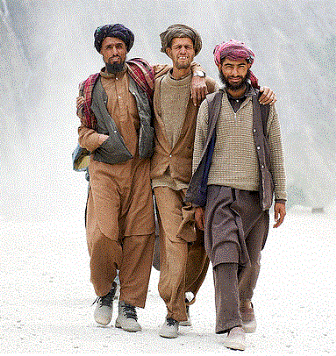
A case study in Sandel’s first chapter makes clear how modern society is questioning the value of these theological virtues. Four members of a special services unit are sent on a mission in Afghanistan. Before they get to their objective they come upon 3 shepherds, one a young boy. Circumstances leave them only two options: kill the shepherds or let them go. A Christian has the final say and reported his “Christian conscience crowded in on him,” preventing him from killing unarmed people. An hour and a half later the unit was attacked by a force of at least 80 Taliban. Three of the mission as well as 16 others trying to rescue them were killed. The Christian survived and called this “the stupidest, most southern-fried, lame-brained decision I ever made in my life.”
That leaves us with two questions to ponder. 1) What values should our pluralistic, democratic society promote? 2) Was the Christian’s conscience to blame for the death of the nineteen soldiers? You can post your answers by either e-mailing me at fritzafoltz@embarqmail.com or by posting on the Website, https://frontlinestudy.com/