The big question in modern ethics is agreeing on what is just in a pluralistic, often democratic world. How do we determine the right thing to do, if we all do not accept the authority of a king, a god, or some common values?
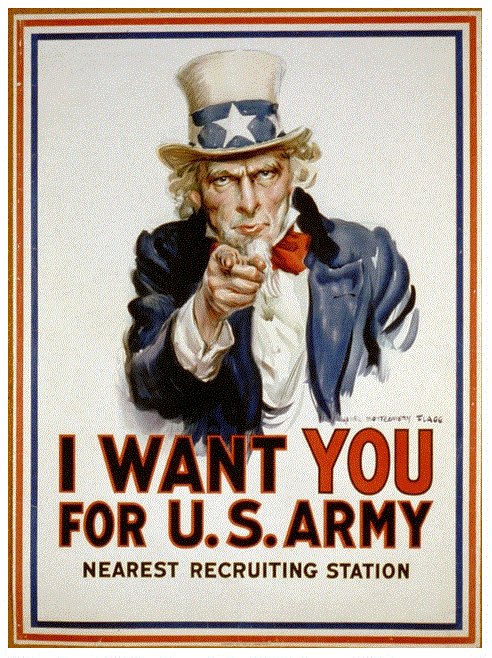
The modern answer is often to turn in default to the Free Market. In Chapter 5, Sandel offers numerous arguments to show this can lead to a conflict between individual liberty and civic responsibility. His first example is the volunteer army– something that I imagine most of us prefer over the draft.
I think the argument boils down to the problems that occur when we treat government like a business. When members of my congregation asked me to remember the Church is a business, they meant we have to ignore some church teachings, if we want to please our contributing members. So, too, when we treat government as a business we bypass some important ethical questions about the rights and responsibilities of citizenship.
For one, we treat our soldiers as employees of the military industrial complex. A volunteer army makes it easier for aged politicians to declare a state of constant war that places young people from predominately lower classes in peril. It brings profit to one of our few remaining successful industries. It brings relief to our unemployment problems.
Beyond that, it gives priority to financial considerations above human dignity. In 2007, we had more military contractors, like Blackwater, than servicemen in Iraq. Nothing prevents these from hiring foreign mercenaries to fight our wars. It also subjects us to the elephant in the room of which we all refuse to speak– that the goal of modern business is to replace humans with more cost effective technology. Our military is already using drones; soon we’ll have robots fighting.
Of course, we can see advantages in all this. But we must also be aware that it enables us to ignore traditional ethical considerations, such as our accountability to just war theories and international law. We too easily justify torture, preemptive strikes, and civilian causalities.
Many believe it also bypasses the responsibilities of citizenship. They argue for some form of compulsory civic service, whether military or civilian. The oath taken by new citizens seems to suggest something like this: “I will support and defend the Constitution and laws of the United States of America against all enemies, foreign and domestic; that I will bear true faith and allegiance to the same; that I will bear arms on behalf of the United States when required by the law; that I will perform noncombatant service in the armed forces of the United States when required by the law; that I will perform work of national importance under civilian direction when required by the law; and that I take this obligation freely without any mental reservation or purpose of evasion; so help me God.”
The Church offers no definitive answer as she has struggled with the place of the military over the centuries. Some believe Christians should all be conscientious objectors; some that we can participate in just wars; and some that it is our duty to do whatever the government asks. However, all theologians try to avoid subordinating human employees to financial consideration.
It would be interesting to know what other nations expect of their citizens. We have readers from Italy, New Zealand, Bolivia, and China. Would any of you inform us?