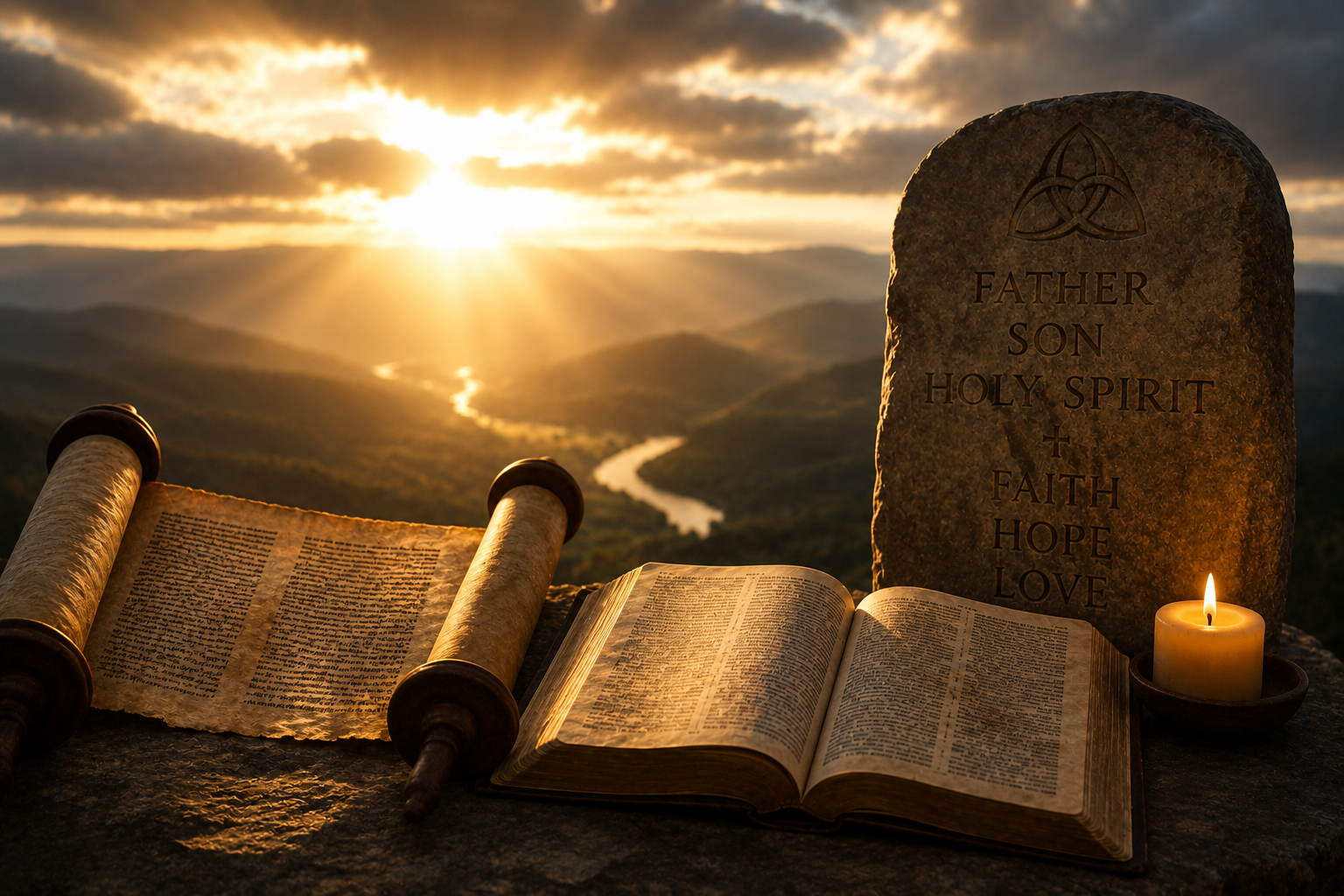
With all the focus on the Bible (canon) we often pass over how the creeds go even further in determining what is and what is not the Word of God. In some ways the canon is like the Constitution and the creeds like the Bill of Rights. The early Church kept adding phrases to the Apostles’ Creed to resolve conflicts that developed. The Nicene and Athanasian Creeds were written in the fourth century to settle disputes over major doctrines.
The creeds also establish priorities for the way we read the canon. For instance, they adopt a Trinitarian understanding of God that is not completely explicit in the canon. They also emphasize the New over the Old Testament and the Gospel over the letters. Even more they make clear we are to understand the Gospels proclaim Jesus is God whose critical actions are his Passion and Resurrection rather than his miracles and teachings.
At the same time, I do not think the creeds demand complete agreement on every last item. Like the canon and Lord’s Prayer they are primarily tools for worship that express the views and practices around which the community can comfortably gather. I always am uneasy about people who feel they can not be baptized or share the Communion meal, because they do not rigidly believe certain rigid interpretations of every last phrase in the creeds.
In fact, this is one of the most common problems in writing modern creeds. Groups use them to champion their understanding of a doctrine as if it is the one and only way to be a Christian. For instance, we sometimes forget that American Fundamentalism is a modern creed based on the 12 volumes sent to every U.S. religious leader in 1909 by two wealthy oilmen, Lyman and Milton Stewart. This creed insists Christians must not only believe 1) that the Bible is inspired by God, but also that every last word is inerrant, 2) that Jesus is divine but also that the essential proof of this is his virginal biological birth, 3) that Jesus died for our sins but also that this is must be explained by the substitution atonement theory that claims God demanded someone had to be punished for humanity’s sin, 4) that God raised Jesus in a bodily resurrection but also that this includes his literal return on the Mount of Olives in the Second Coming, and 5) that miracles appear in the Bible but also that you must accept the objective reality of everyone of them.
Clearly the canon and the creeds help us determine if an inspiration is really God’s Word by providing standards we can use. At the same time, I think it is very important we see these standards have a great deal of flexibility so they can be relevant even 2000 years after their writing. So far the most frequent concern expressed by readers of this study has been the need to appreciate how God’s Word applies to particular times and places. These readers talk of the need for the faith to help people live their lives in the real world. Preserving this flexibility built into canon and creed goes a long way in addressing their concern.
Next week I’ll take a look at how other parts of the tradition play their role.