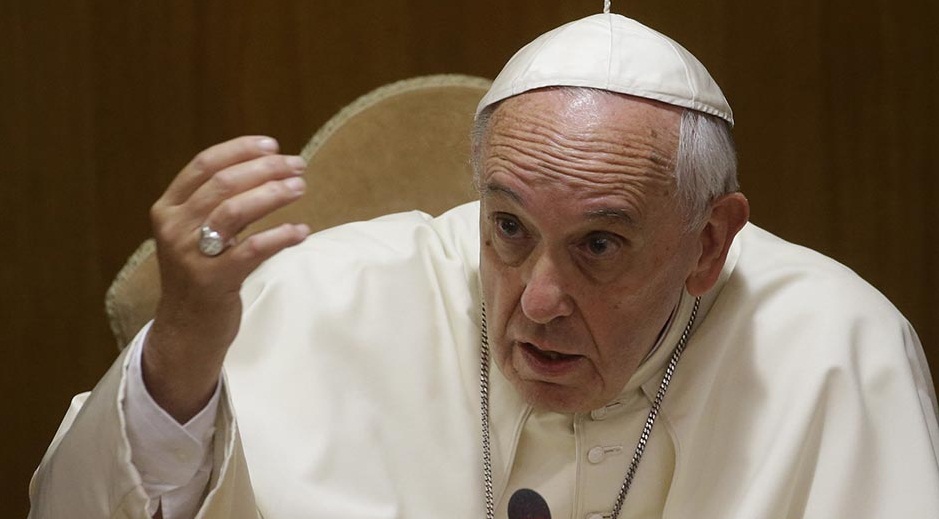

There is no doubt that Pope Francis’ theology of the spirit is an outgrowth of the liberation theology prominent during the middle of the last century in Latin America. He literally echoes the preference for the poor that they advocated. Many of you might remember this group featured priests gathering the poor for small group Bible studies that focused on applying the Gospel to their own lives. They gained attention when the participants were inspired to improve their situations through united political action.
This was extremely controversial at that time when conventional wisdom called for separating religion and politics. In a kind of democratic two kingdoms arrangement, the Church was supposed to focus on inspiring individuals to be good people and the State was to provide the law and order that enabled this to happen.
By the end of the 1970s, the Vatican began condemning this theology for being too political. Most of my friends thought the real reason was the participants used Marxist theory to understand their situations and soon came to accuse the Roman Catholic hierarchy of being part of the oppressing upper class. The magnificent motion picture, “The Mission,” forcefully presents our perspective.
Obviously, there have been some big changes that allow Francis to get away with his views. The first undoubtedly involved the Evangelicals, who had been the most vocal advocates for keeping religion focused on an individual’s personal relationship with Jesus. They suddenly realized they had to play politics if they wanted to have a voice in modern society. Right when the Vatican was silencing the Liberation leaders, Jerry Falwell started the Moral Majority to oppose the abortion and homosexual movements that were rapidly gaining power. In 2009, many prominent conservative Roman Catholics signed the Manhattan Declaration indicating they were ready to join the Evangelicals in joint political actions.
Pope Francis sees this about-face reflecting a reality in our modern technological society that forces Christians to transform oppressive structures as well as self-serving individuals. Throughout Evangelii Gaudium, the Pope rather offhandedly claims that technical systems have replaced human culture in our global society and that individuals have pretty much become replaceable parts in these enduring systems. His supporters read this as an accredited sociological analysis. His critics perceive a lingering Marxist perspective that reduces everything to economics.
Who cares about that? The Pope calls our attention to a new poor created by the exploiters and entitled in the modern financial system. He mentions the homeless, the refugee, the immigrant, the addicted, the unborn, indigenous peoples, and the elderly as examples of people given no place, no voice, and no personhood in this system even though they pay the price for its failures. If God hears the cries of slaves in bondage to Egypt’s political system and comes to free them, and if the Father of Jesus Christ hears his cries when executed by political and religious authorities and comes to raise him to life, then his worshippers should act to free and give life to those who cry out from the pain inflicted by the systems in our society.
It is time to drop trying to silence Jesus’ followers by keeping religion separate from politics. Nearly every page in the Bible has a political dimension. Now more than ever, a Gospel that is good news for the poor has political ramifications. There might be no pure Christian programs or parties, but advocates of humanity are called to care compassionately for the poor. I wish the Pope would be even more vocal and outspoken.