
Bonhoeffer’s arrest prevented him from finishing what was meant to be his greatest work. Back in seminary, I rather hurriedly read what we have of the Ethics as an academic study and was unimpressed. I reread it in the past few days as a historical statement and found much to ponder and admire. In fact, I constantly found myself applying his observations to our present situation.
Bonhoeffer never mentions the Nazis but clearly offers a chilling assessment of the society they have created. He claims Western civilization has lost its historical inheritance. The orders of creation are no longer stable; sins are no longer hidden. “Today there are once more villains and sinners, and they are not hidden from public view. Instead of the uniform grayness of the rainy day, we now have the black storm-cloud and the brilliant lightning flash. The outlines stand out with exaggerated sharpness. Reality lays itself bare. Shakespeare’s characters walk in our midst. But the villain and the saint have little or nothing to do with systematic ethical studies. They emerge from primeval depths and by their appearance they tear open the infernal or the divine abyss from which they come and enable us to see for a moment into mysteries of which we had never dreamed. What is worse than doing evil is being evil.”
In this situation where evil literally threatens the world’s survival, ethics becomes saving humanity from throwing itself into the void. Because reality cannot be known apart from Christ, this means asking “What is the will of God?” not “How can I be good?” or “How can I do good?” Responsible ethical action has more to do with moral formation then decision making, because its goal is participation in the divine reality that Christ reveals.
Bonhoeffer thinks ethics has two tasks in these penultimate circumstances. The first is to inspire a new awakening or reformation of the Church, because it is there ethical formation takes place. Bonhoeffer describes this ethical formation as justification by grace through faith. It accepts guilt so forgiveness of the past can take place; it accepts freedom so renewal and a new beginning can take place. Christian life is the dawning of the ultimate in the penultimate, and the Church is where the ultimate is available to us.
If a person must be good before her work is good as Bonhoeffer maintains, then ethical formation depends on Christ’s atonement. God’s love reconciles and transforms us so that we begin living like Christ. As he did with costly grace in The Cost of Discipleship, Bonhoeffer uses the Sermon on the Mount to describe the Christian life.
Acknowledging all this takes place in the context of the penultimate situation, he writes that a second task of the moral life must be the restraint of the evil threatening the world. This might be part of the book that was never completed. At least, I found it difficult to understand exactly what it entails. At one place, Bonhoeffer describes it as establishing order that I assume means applying the law. He mentions various actions that extend from feeding the hungry to providing defense. As I was reading these short sections that acknowledge restraining evil might mean taking the burden of guilt upon ones self, I imagined Bonhoeffer could be considering the assassination plot.
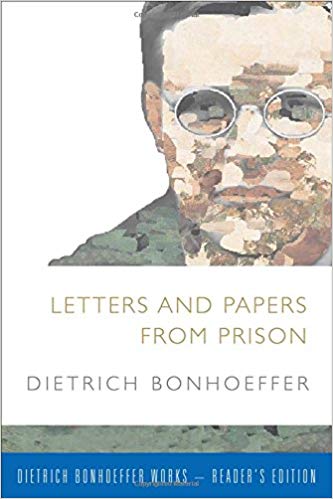
That brings us to the Letters and Papers from Prison where Bonhoeffer muses about the need of a religion-less Christianity in a world come of age. It is helpful to remember in the Ethics the world come of age is described as a new religion based on hostility towards God. Bonhoeffer sees it as a threat to human culture as well as the Church, because it has lost contact with reality. Perhaps we want to keep this in mind as we tackle the Letters next week.