

A change seems to have taken place in the relationship between church and society. Although it was long coming, most of us did not pay much attention until the recent presidential campaign. It was taken for granted that church and society had a congenial working relationship. Many even spoke of the church as the cutting edge of society, pioneering practices that would eventually become the law. Suddenly, things seemed to have turned completely around. Many churches now are afraid the government will force them to engage in practices they regard as the direct opposite of their beliefs.The catalyst for this disillusionment with society and government has been the performances of the candidates.
A telling example is the change in the Roman Catholic-Evangelical alliance that was formed to lobby the government for laws opposing abortion and same sex marriage. The alliance has pretty much given up thinking they can change societal law and now focuses on preserving religion’s freedom to practice their own values. Many others, including myself, are far more troubled by economic and political practices.
In response, many are asking the church to provide more guidance in leading a Christian lifestyle. They not interested in sermons offering therapy to cope with the anxiety of living in this society or asking for money to support experts doing specialized ministries. They have become cynical with parochial theologies that continue the divisions in the Body of Christ and self study projects that aim to change institutional programs, especially when they are touted as projects of the Holy Spirit. Thoughtful Christians are searching for ways they themselves can follow Christ in this fragmented society, and often they are forming new communities they hope will nourish, enrich, and inspire them.
In this situation, a servant ministry in which members share spiritual gifts seems far more appropriate than an authoritarian one in which a pastor dominates. The model since the 16th century has been an educated clergy teaching a congregation in which there were few other learned folk. Today many, if not most, of the laity are more highly educated than the pastor. Discussion shared between equals around a meal table offers more potential than lectures from experts. People want to hear the thoughts and experiences of laity as well as clergy.
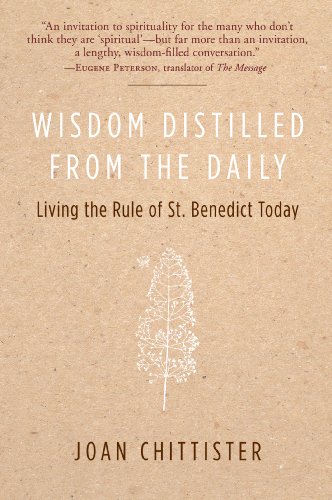 A critical concern then becomes identifying the Christian principles that might define this kind of community. Every time that comes up, my thoughts return to a book written by Sister Joan Chittister many years ago. She very simply laid out the fundamentals of the Benedictine Rule that provided the foundation for Christian community in 6th century pagan society, describing it as “written by a layman for laymen” and “designed for ordinary people who live ordinary lives.” She recommended it for modern Christians who are attempting “to live calmly in the middle of chaos, productively in an arena of waste, lovingly in a maelstrom of individualism, and gently in a world full of violence.” I am going to review her ideas in the coming lessons. You can follow, if you want, in her book, Wisdom Distilled from the Daily: Living the Rule of St. Benedict Today.*
*purchases benefit St. Jude’s Children’s Hospital