
What is John up to? Seems to me he is tackling perhaps the most difficult problem of Christianity: how to explain what it means to proclaim a human being is God. There is no way you can convey how he does this inside the limitations of an electronic blog, so what I’ll offer is theological shorthand.
You could read the other three gospels as if they claim Jesus lived such a perfect life, especially in his death, that God raised him up and gave him equal status. John offers an incarnational theology that claims Jesus is simply the manifestation of God as he is forever. The Crucifix is the Christian image best associated with the first approach and the Madonna and Child with John’s.
His first sentence indicates John is going to do this by combining Hebrew and Greek traditions. “In the beginning was the Word, and the Word was with God, and the Word was God. He was in the beginning with God.” It echoes Genesis 1 where God’s spirit moves over the waters of chaos and creates by speaking words. God is a spirit beyond human control or knowledge who relates to humans through words. In the Old Testament God’s Word, especially the Law, represents him in our world. His people cannot see him and live. They are to refrain from attempts of make graven images of him. Everything is word.
You also see John using ideas from many Greek philosophers who saw Reason as a principle permeating all things. The Reason shared by all people and things makes it possible for us to communicate with each other and know what is beyond ourselves. It enables us to make common sense from the Kaleidoscope of sense experience. Many philosophers associated this with Logos, the spoken word that is Reason’s primary tool.
John seems to feel justified doing this, because of the Old Testament Wisdom tradition is very compatible. His second sentence “All things came into being through him, and without him not one thing came into being. What has come into being in him was life” echoes Proverbs 8: 23-36.
So John can say God, the Word he characterizes as Real Life and Light, has always been among us even though we did not discern Him. “The life was the light of all people. The light shines in the darkness, and the darkness did not overcome it. He was in the world, and the world came into being through him; yet the world did not know him.”
He was always with his own people, the Israelites, in a special way; but most of them rejected him. “He came to what was his own, and his own people did not accept him. But to all who received him, who believed in his name, he gave power to become children of God, who were born, not of blood or of the will of the flesh or of the will of man, but of God.”
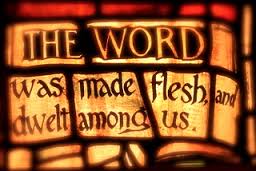
So God came among us as a human to make apparent who he is and what he offers. We are now dealing with personal relationships rather than intellectual concepts. Next week we’ll look at what John means when he proclaims, “The Word became flesh and dwelt among us.”
But in the meantime, take notice of what John’s definition of God offers. It is much more profound than the silly ones being tossed around in our society these days. God is not a supernatural man somewhere out there who has the power to do as he pleases. He does not mechanically start up the universe and then for the most part sit back. John makes clear he is not speaking of creation as a moment in the past that gets things started. God’s Word is the source of all life, the ultimate reality on which all based, but it also still sustains life and permeates all things. Creation is an ongoing activity. The daily Jewish prayer that thanks God for renewing creation every morning acknowledges this.
Notice, too, John does not offer a picture of God intervening by breaking natural law when he is provoked or summoned in prayer. God as ongoing creative spirit has no trouble with scientific findings or evolutionary theory. They are simply part of the story, the way God operates. Once you get thorough the awkward language and repetition, you find John’s incarnational theology has a lot to offer our modern technological society.