So forgiveness pre-requires understanding the mistakes of the past? here hear re this opposing this me-first, America-first, white-first, male-first approach>…
Lesson 5: The Bridegroom and the Lamb
•
•
comments

Comments
5 responses to “Lesson 5: The Bridegroom and the Lamb”
-
As the world gets smaller and the universe gets larger, our old, small ideas become inadequate. We are forced to think in other terms, other dimensions. The Higgs Boson particle, like quanta, seems to defy intuition and challenge many things and concepts we thought immutable. These and other challenges to the old perceived standards force us to rethink even our deepest certitudes. In this light (and lets admit it’s a brilliant, difficult light) our image of God and of the interaction of humans with God has to be different.
In a vision of an “n” dimensional universe, God has to be both closer and more intimate and much more visibly omnipotent and omniscient than ever before. The Lord who spoke with Abraham in the garden and the God who created billions of galaxies with trillions of planets must be the same, but we must now see him with a different understanding of His greatness. Thinking that the God of this expanding universe must be distant and indifferent is to limit his omnipotence, but assuming that his only concern is with us, with our petty squabbles and rigid dogma, limits his greatness as well, and won’t do. He must be both immense and accessible. There are those who say “if there should be a force, a being who “started” it all with the big bang, it would be a force so hugely powerful it would never have anything specific to do with small motes in the universe such as humans”. That is as narrow-minded a claim as to insist that God exists for us only, and is forever looking over our shoulders.
God, without limitations toward the infinitesimal or the infinite, must be accessible, but He is not in our neighborhood. Any attempt to make God parochial, to keep him in down to the Biblical God of a single nation; to have Him rain brimstone and fire down on the heads of the wicked and Calvinistically shower the righteous with wealth, is a vision that fails spectacularly in the global scale and is simply irrelevant in the universal framework.
Were Stalin and Franco and Pinochet – in spite or the myriad lives they took- especially blessed by God because they lived to a wealthy and ripe old age, dying in their beds with family and the subservience of their people? Are Mandela, Gandhi and Mother Teresa people in their poverty punished by God? Are there absolute minimal administrative or dietary requirements for salvation? Could Aristotle and Plato be damned for eternity for not being Christian?
Those old standards obviously cannot be enforced, and yet some canons must exist: there is good and evil, and virtue and sin. As Pope Francis bluntly says, we are all sinners, even if on different levels and intensities, but our definition of sin must be higher, more spiritual, less obsessed with the flesh. We must be able to strive for something larger. There has to be a higher purpose, a more sublime sphere or else, could there be meaning to what we are discussing? I use the word sublime with some trepidation, because it has been so overused in other contexts, but I believe it describes what must be our collective aspiration.
Religion has gone through many stages and phases. Christianity itself has been in crisis more than once. The Catholic Church (I cannot speak of any other) long tried to keep –by conversion or force- intact its late-medieval encompassing power that allowed the Pope to make and unmake kings, grant absolution for sins, and even forgive future transgressions; a time when the Church could sanction the deaths of millions in Africa or the New World, simply because they had been “redeemed by baptism” before being enslaved or put to death. Though this struggle for continued power could not, and did not hold. Reform within and outside the Church became necessary, and went through many forms and stages, as you have pointed out in your paper.
However, the reforms must continue to keep pace with the world if the Church is to live with the needs of the faithful. We live in the midst of unprecedented change, scientific and social. No longer can we speak in such plain terms as “mother” or “father”, when we have such things as surrogate mothers, artificial insemination, sperm and egg donors, or the possibility looming right over the horizon, of cloning. No longer can we so clearly speak of “homosexuals” when there is such a wide range of gender-associated choices (or fates). How about the normal looking boy who has female ADN, or the little girl with male ADN but no male organs? And are uncounted decent, even heroic gays like the selfless attorney who has defended my case in the Inter American Human Rights Commission Pro Bono for eleven years to be damned forever, though he is a good and generous and hardworking person who was raised a Catholic, who believes in God, but who, with his partner -now husband- of 18 years, cannot accept ancient Biblical strictures? How about me, divorced not by my choice but of necessity, though I have never married since. Shall I be forever denied the sacraments? Here I must say that after a good talk with the marvelous parish priest who married us and later told me to take contraceptives in good conscience after three children in three years, I have now partaken of the sacraments without a qualm. All the same, I have felt shouldered aside by a Church with inflexible and infallible rules, though the particular infallibility of that infallibility dates only to 1870.
Any simple arithmetical progression can show anyone with an open mind that continued simple “increase and multiply” of humanity is a recipe for global disaster. Contraceptives, which act before any conception occurs, should have been hailed by those who insist that life begins at conception, but up to now, saying the use of contraceptives is not a sin has remained as the secret of the confessional, and up to a few enlightened priests.
The Catholic Church’s old men in red, in contradiction to mathematics, medicine and logic, (at least in public) still stoutly proclaim relentless reproduction to be God’s divine will. And if we add the cilice to the regulations laid down by Jose María Escrivá de Balaguer, founder of the Opus Dei, could the Catholic Church heading back to the Middle Ages?
In this scenario, Pope Francis is a breath of fresh air; an erudite mind with an open heart; a brilliant thinker with humility and genuine feeling. In the interview you sent us, he uses as sources Opera, or film (Fellini’s La Strada, no less!) or literature, not only the Bible. The latest pictures of him embracing a grossly deformed man with such clarity of love, are revolutionary in Vatican terms. The fact that he eschews the papal apartments, the throne, the jeweled crucifixes and the sumptuous settings, and is forcing the Curia to adhere to austerity maxims long abandoned, are revolutionary as well. Will the old men in red continue to believe that Francis was chosen by God himself (through their divinely inspired vote) and follow his lead, or will they close ranks and fight against him for the old order? Francis will perhaps, a significant turning point, a beacon toward new openness.
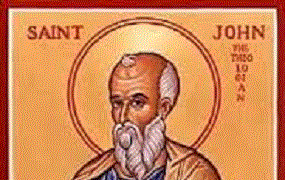
The Pope quotes John, and this is inspiriting. I believe that John, the most visionary of the Evangelists may also be the most modern. He seems to deal, most naturally, with abstract concepts that almost reach the realm of theoretical physics. His repeated use of Light as synonym for God is fascinating.
In the beginning was the Word, and the Word was with God, and the Word was God.
1:2 The same was in the beginning with God.
1:3 All things were made by him; and without him was not any thing made that was made.
1:4 In him was life; and the life was the light of men.
1:5 And the light shineth in darkness; and the darkness comprehended it not.
and
8:12 Then spake Jesus again unto them, saying, I am the light of the world: he that followeth me shall not walk in darkness, but shall have the light of life.
I’m using King James’s version here, but it does not change substantially in later versions. John’s Light reaches everywhere, illuminates everything, is the basis, the beginning. I cannot add anything to that magnificent image of God and creation. And the use of the Word in that exalted sense (Verbum, in Latin, and the very close Verbo, in Spanish) touches me most deeply, as I have lived my life by words, be they stumbling, like mine or glorious, like John’s. -
Lupe proposes a bold rethinking of traditional Christianity to fit the expanded perspective of modern life. In reading her her comments, I was reminded of the old saying “How odd of God to chose the Jews.” Of course Christianity has moved beyond simply the religion of a small group of “Chosen People” in a remote part of the world, Still the entire Old Testament is based upon this concept. Her program is attractive. It runs into what I always note as a obstacle in rethinking any religion — the desire for certainly. I think a re-conceptualized Christianity may well make more sense in today’s world, but I am cynical about such a Christianity becoming widely accepted and embraced.
-
Thanks, Lupe, for the vision of a Christianity we can all believe in. I share your admiration for the current Pope. He is not a liberal in the political sense, but he is certainly a liberal in the true meaning of the word: freeing. I have no expectation that any of the Church laws/rules are going to change in the near future, but I remember hearing once that if a law goes into effect and nobody really obeys it for 25 years, it is no longer a law that can be enforced. (Think contraception and Humanae Vitae).
Having spent a weekend at Kirkridge Retreat Center in September with Michael Morwood (silenced Australian priest, now married), my own belief system was “stretched,” to say the least. I’m still working through many of his insights, but I believe he is closer to the truth than what I usually hear from the pulpit.
Thanks again for your wonderful posting. -
The Jehovah’s Witnesses (originally called Russellites) started with the promise “millions now living will never die.” An exact date in the near future was set for the Second Coming. Of course that date came and went. Recalculation was necessary. My guess is today the Jehovah’s Witnesses don’t promise an exact date.
In the New Testament it states clearly that the date of Christ’s return is not known. There are, however, many indications that it won’t be very long in the future. Thus early Christians may have been like the early Russellites, expecting the Second Coming during their lives or soon thereafter. When this did not happen, it must have presented a problem for the new religion. Some must have seen it as a religion of a failed promise. John, as Fritz notes, moves up the benefits of believing in and following Christ (and also the suffering) to now, not the near future. Such a re-conception of the message may well have been necessary at the time John was writing.
-
Jesus says, Follow Me, Come and See. These are personal invitations of welcome to join in the transformation of the old into the new, of the toxic darkness to the light of compassion, love.
All Jesus’ miracles, his sayings, many of the parables, his encounters with ordinary or outcast people
along the way demonstrate this love. John, the disciple whom Jesus loved, witnesses and relates Jesus’ love, and who later will outrun Peter to the open tomb, who will hesitate to enter, yet humbly believes in the ascendant Jesus.Applying personal Christianity to daily life, and then to the wider world stage, requires determination, hope,doubt, forgiveness, and faith. This can be a lifetime. The prayer of Teresa of Avila
might be helpful to remind us of what we can be., personally, . and at large in Christian institutions.
Leave a Reply
Recent Comments
An extremely timely topic. Thanks, Fritz!
yes we need to forgive our leaders yet make sure they do the right thing – which they aren’t.
More posts
-

Lesson 1: The Reading Groups
Read more: Lesson 1: The Reading GroupsMany years ago my daughter and son-in-law asked me to lead a reading group for a few high school students. Before long it became apparent many more were interested in discussing their faith seriously. At…
-

Lesson 2: Speaking For God
Read more: Lesson 2: Speaking For GodAll three of our youth groups are very troubled with those claiming to speak for God when uttering hate messages. Twice during the last year the High School Reading Group wanted to talk about Westboro…
-

Lesson 3: Ben Laden’s Assasination
Read more: Lesson 3: Ben Laden’s AssasinationBob is quite right when he warns that our response to the actions of those we oppose too often plays into their hands. You see this in many of our reactions to 9/11. All three…