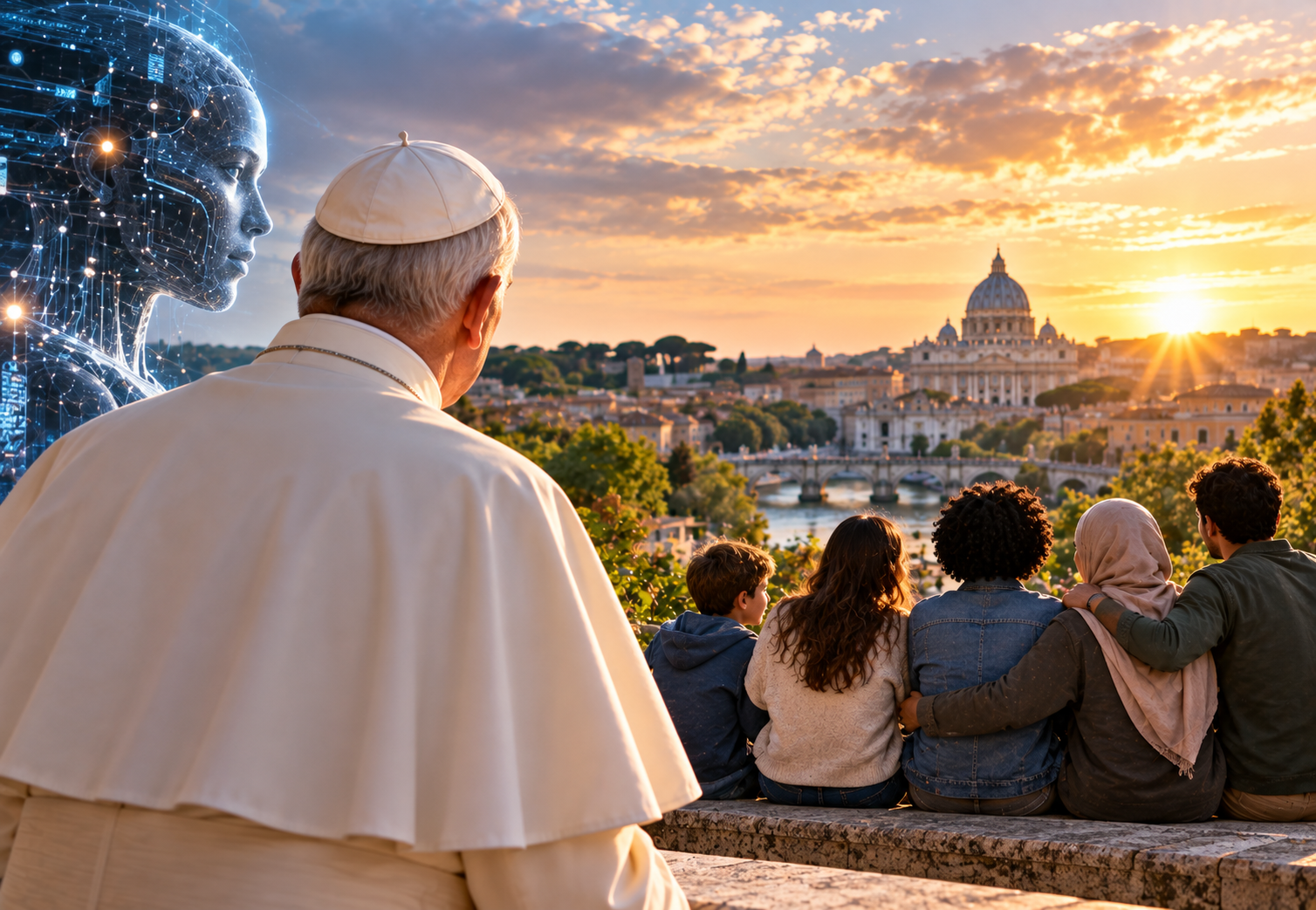

It has taken me a while to understand why the term “civilization of love” caught my attention. After reading far more encyclicals than I intended, I realize it is because the popes are attempting to answer a major challenge of our time: the need to develop a new institutional ethic.
Determining moral principles has always required confronting the natural human tendency to base relationships on “might makes right.” The strong have often prevailed in neighborhoods and nations.
Over the centuries, efforts to control this have taken many different directions, depending on circumstance. A good example is the history of Christianity.
For four centuries, the early Church taught nonviolent love in all situations. When Christianity became the accepted religion after Constantine, it suddenly had to defend its neighbors from evil. That meant changing its teaching, and it did so again and again over the centuries.
In recent times, the Church handled this by establishing different ethical standards for personal, economic, and political relationships. On the personal level, nonviolent love was still the standard. On the economic level, the market spoke, but the powerful were checked by regulation, such as laws prohibiting monopolies. On the political level, the state could use violence to control evil, but again checks and balances, such as just war theory, protected the weak.
These arrangements have broken down in our time, as technology’s tremendous power has enabled strong individuals, corporations, and nations to bypass regulations.
This has created a need for new institutional ethics, and the popes have attempted to meet it by calling for a civilization of love.
It includes two radical changes. The first is recognizing that we now operate in a global society. Corporations, and even individuals, are now more powerful than most nations. We must establish international laws and structures to govern them.
The second is recognizing that Christian ethics must operate in love at every level. The popes insist love is a dimension in all decisions, even economic and political ones.
We desperately need to develop institutional ethics. Christian Nationalists have already broken down the wall separating church and state as they try to impose their agenda on the entire nation, often calling for violence.
On the other hand, many secularists claim it is time to recognize that the empathy inspired by love is a weakness preventing the growth of Western society.
The popes lead the way by calling on our culture to care for the weak in a civilization of love.