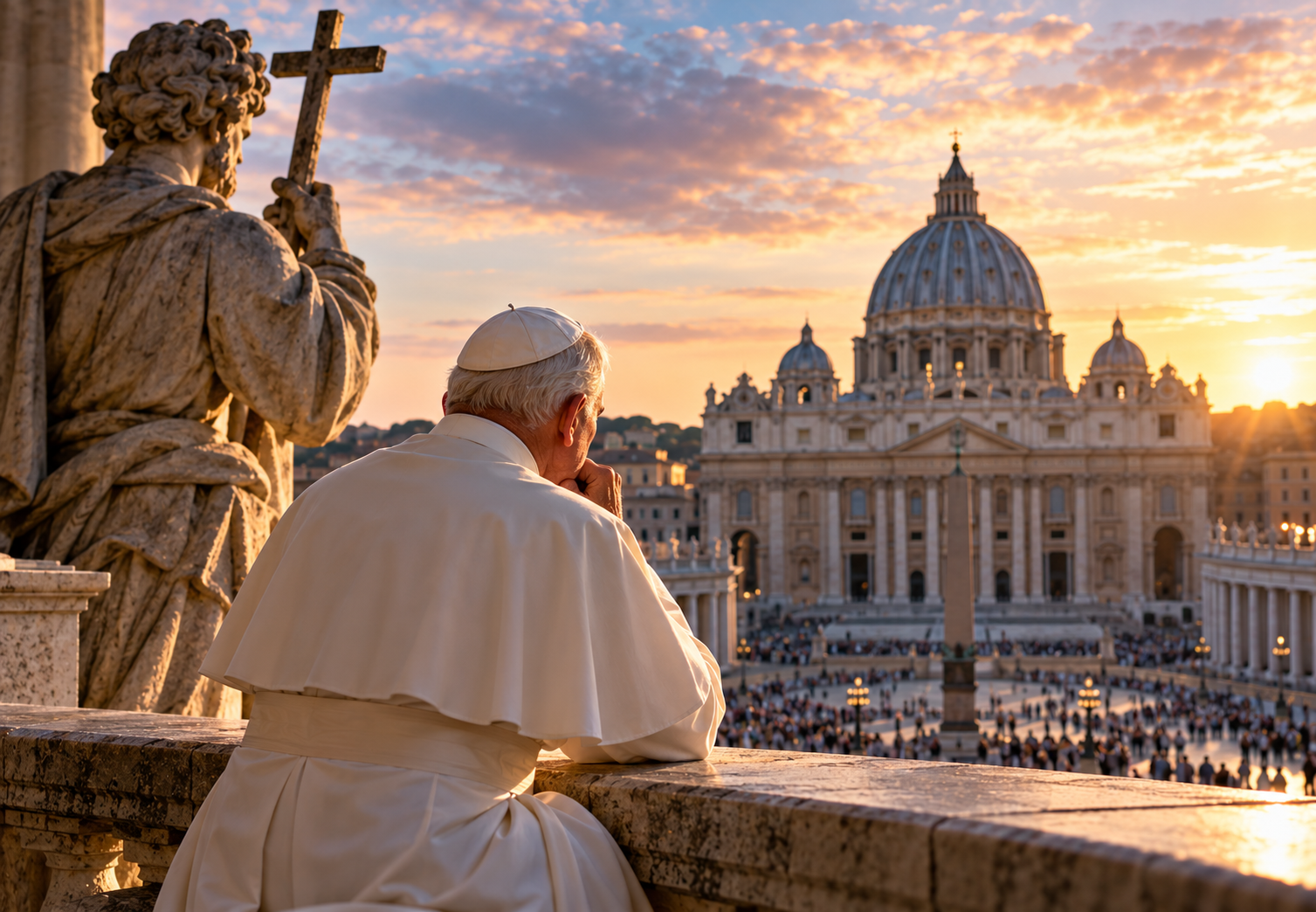

Ever since the 1960s, the popes have called on audiences, especially youth, to build a civilization of love. At the time, many Christians grew uncomfortable with American society.
Jerry Falwell and Pat Robertson warned evangelicals that secular society was trying to close down churches for opposing abortion and homosexuality. They advocated getting involved in politics to rebuild a Christian society. Their movement did not rule out using violence to overcome evil, and it led many into Christian nationalism.
The popes countered with a far more comprehensive understanding. Benedict, in particular, responded to many prominent conservative Catholics allying with the evangelical movement by going beyond the sexual issues. He spoke of a dehumanization taking place in the modern technological age, one that prioritizes efficiency and utility. In politics, separation of church and state enabled the government to use unregulated violence. In economics, total reliance on the market allowed unbridled competition.
Building a civilization of love would restore humanity by considering the moral aspects of every political, economic, and sexual decision, even at the national and international levels.
Although the popes used the word “love,” such a civilization was based on natural law. Benedict spoke of love purifying reason by adding an essential dimension to truth, justice, and freedom.
Most mainline Protestants can appreciate almost everything Benedict wrote. Wanting to welcome all and to avoid absolute laws, they might have trouble with his treatment of opposition to homosexuality and abortion as a litmus test. Still, they can resonate with the ideas in his two most important encyclicals.
In Deus Caritas Est (2005), he writes: “Everything has its origin in God’s love, everything is shaped by it, everything is directed towards it. Love is God’s greatest gift to humanity, it is his promise and our hope.”
In Caritas in Veritate (2009), he goes on to show how this applies to economics, echoing Pope John Paul II’s radical claim that the market must be critiqued by love.
He gives us a lot to ponder as we consider the potential of building a civilization of love.