All posts tagged body of Christ

Lesson 8: Nurturing Community

Nurturing CommunityLet’s resume examining Practical Christianity, that part of the Christian life that does not necessarily involve the supernatural. In my ministry, I found many people came to church or sent their children, not because they wanted to worship, but because they sought a community that would give meaning to their lives– a place where they could discuss who they are, what they believe, and what they are to do.

Before my winter break, I looked at faith offering ways to overcome the evil of this world and the problems in our personal lives. Sometimes this involved praying for God’s help; sometimes just living by teachings, such as returning good for evil, that offer some promise for making the better world we desire.

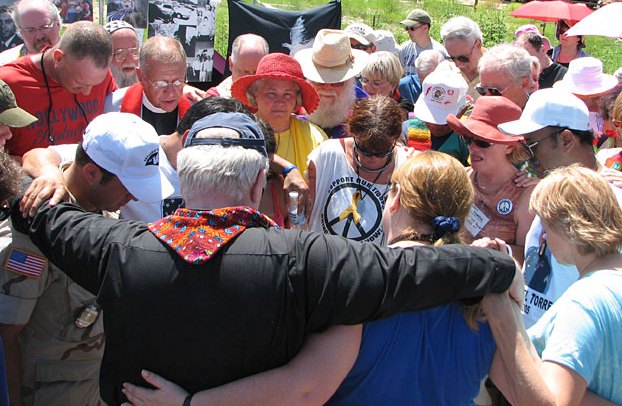
Now let’s consider a second practical aspect. People come to church seeking a nurturing community. Some see this as the Body of Christ resurrected on earth, but others see this as simply a healthy, decent community of people with whom they want to associate and discuss issues that are truly important.

Part of this nurture is the variety of people who gather. Today, just about the only other opportunity for this is school. Even that is being threatened by our current economic practices. Where else do all generations interact? Where else do people practice rites of passage such as baptism, confirmation, marriage, and funeral? Where else do we ask our youth and new members to promise publicly they will work for peace and justice in all the earth?

Most of us would answer “the family.” It is the one place we can practice unconditional love and voluntary communism. Each contributes according to his or her ability and each is allowed to take according to need.

Perhaps the secret to the good life that Jesus proclaims is finding the courage to extend this beyond the biological family. He calls us to a community in which God is Father and all humans are brothers and sisters. Jesus offers himself as the primary example of the greatest serving the least. Paul proclaims that faith in Christ Jesus enables us to enter this community in which there is neither Greek nor Jew, rich nor poor, male nor female, free nor slave. Acts describes the first community selling their possessions and distributing the proceeds to all as any had need.

Before we can ask anyone to extend this community any further, we shall certainly have to provide a better example of this Servant Church. That means no longer pretending the Church is an institution or organization that preserves old values but rather a community that nurtures new life. It also has little chance of happening until we base this community on the relationship with God given in worship.

Next week I’ll look at how sharing meals is a key to implementing this. For now, what do you think about presenting the Church as extended family in which we are called to find more and more ways to complete the extension beyond ourselves?

Lesson 7: Community

Love Thy NeighborThe third practical way Christianity offers for overcoming suffering and evil is a loving, sharing community. Lupe observed suffering can be made “less terrifying when families envelop each other in love.” Certainly the New Testament sees this extending beyond the biological family to the entire Body of Christ.

One of the many places Paul mentions this is in the Romans 12 passage I used to support “returning good for evil.” In this summary of the Christian life Paul states, “We, who are many, are one body in Christ, and individually we are members one of another…Love one another with mutual affection; outdo one another in showing honor…Rejoice with those who rejoice, weep with those who weep. Live in harmony with one another.”

Jesus promises this kind of community when he says he will be present when two or three of us gather in his name. In some ways, his and our presence is more important than any words that are spoken. Still the words enrich the experience. When we put our sufferings into words for others, we find we can better understand and handle them. When they respond in love, we find the support we need.

Hearing words in the community also helps us to discern what God is saying to us. This involves not only listening to the scriptures and sermons, but also to the dynamic, transforming words our companions speak to us, such as “I love you”, “I forgive you”, and “I’ll be there for you”.

It is in the Christian community that we dare speak the truth in love. We acknowledge the reality of the evil that brings suffering upon us, and we honestly access what must be do together to overcome this.

Beyond that, Paul calls us to “Rejoice with those who rejoice and weep with those who weep”. Far too many in our society have no one to share their joys or sorrows, to celebrate their successes or to mourn their failures.

There is not much community in our global society. It has no loyalty to a nation, much less a neighborhood. Individuals compete rather than co-operate, usually with no sense of fairness or honesty. It is only in such an environment that our leaders could use 29.6 trillion dollars of our money to bail out international banks from the consequences of their own greed without any transparency or accountability whatsoever.

More than ever we need Christian community to bring people together over food and conversation. This will not shield us from the inevitable suffering in our world. However, when we share and pray with others, we can endure and even overcome the evil all around us.

My guess is many of our readers are thinking this is not the kind of worshipping community they know. Sadly, this is too often the case. Perhaps that means Christ calls us more than ever to invite others to join with us in creating this means of grace.