
Let’s resume examining Practical Christianity, that part of the Christian life that does not necessarily involve the supernatural. In my ministry, I found many people came to church or sent their children, not because they wanted to worship, but because they sought a community that would give meaning to their lives– a place where they could discuss who they are, what they believe, and what they are to do.
Before my winter break, I looked at faith offering ways to overcome the evil of this world and the problems in our personal lives. Sometimes this involved praying for God’s help; sometimes just living by teachings, such as returning good for evil, that offer some promise for making the better world we desire.
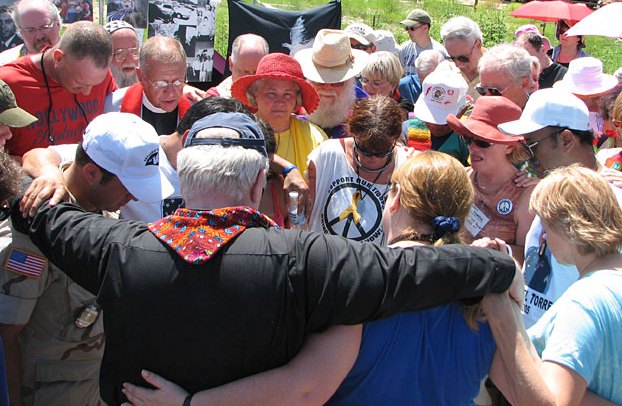
Now let’s consider a second practical aspect. People come to church seeking a nurturing community. Some see this as the Body of Christ resurrected on earth, but others see this as simply a healthy, decent community of people with whom they want to associate and discuss issues that are truly important.
Part of this nurture is the variety of people who gather. Today, just about the only other opportunity for this is school. Even that is being threatened by our current economic practices. Where else do all generations interact? Where else do people practice rites of passage such as baptism, confirmation, marriage, and funeral? Where else do we ask our youth and new members to promise publicly they will work for peace and justice in all the earth?
Most of us would answer “the family.” It is the one place we can practice unconditional love and voluntary communism. Each contributes according to his or her ability and each is allowed to take according to need.
Perhaps the secret to the good life that Jesus proclaims is finding the courage to extend this beyond the biological family. He calls us to a community in which God is Father and all humans are brothers and sisters. Jesus offers himself as the primary example of the greatest serving the least. Paul proclaims that faith in Christ Jesus enables us to enter this community in which there is neither Greek nor Jew, rich nor poor, male nor female, free nor slave. Acts describes the first community selling their possessions and distributing the proceeds to all as any had need.
Before we can ask anyone to extend this community any further, we shall certainly have to provide a better example of this Servant Church. That means no longer pretending the Church is an institution or organization that preserves old values but rather a community that nurtures new life. It also has little chance of happening until we base this community on the relationship with God given in worship.
Next week I’ll look at how sharing meals is a key to implementing this. For now, what do you think about presenting the Church as extended family in which we are called to find more and more ways to complete the extension beyond ourselves?
The third practical way Christianity offers for overcoming suffering and evil is a loving, sharing community. Lupe observed suffering can be made “less terrifying when families envelop each other in love.” Certainly the New Testament sees this extending beyond the biological family to the entire Body of Christ. 
Frontline Study is an online discussion of the scriptures, inviting you to share your comments and your reflections on each weekly topic. Simply click on the "comments" text at the top of each post to see what others have posted and to add your thoughts.
Recent Comments
(Sandel, Chapter 10)