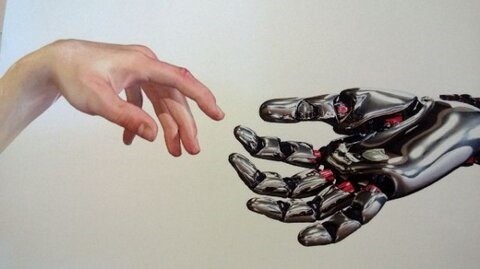

One of the theses of our book is that modern science-based technology has created a society that offers a new kind of challenge to Christian thought and practice. In the past, we thought of technology primarily as using tools to overcome human limitations. Over the years, we added technique, an orderly, step- by- step way of doing a task that enables even those who have little knowledge or skill to perform it. The development of sophisticated tools and techniques in recent centuries has brought incredible improvements to our lives.
Today we think of technology as a system or systems that integrate tools and techniques. These systems have become so huge and all- pervasive that they have created an environment to which we are forced to conform. In order to get about, we pretty much need a car to travel on the vast highway system. If we want to energize our houses, we need to hook up to the electrical grid. And if we want to use email, we need access to the Internet.
As a result, many speak of living today in a technological society. They mean we have come to depend on the many systems out there, more so than people, to supply our needs. It could be said that we trust systems more than other people.
The challenge to Christianity and, for that matter, traditional human culture in general, has come from the new lifestyle practiced more and more in the modern technological society. That lifestyle is characterized by a concept Jacques Ellul called technique. Technique as he used the term meant looking at all life as a problem to be solved by applying a rational process that brings mechanics to bear on that which is spontaneous and irrational. Absolute efficiency becomes the only standard in every field of activity. Everything is isolated as in a controlled scientific experiment. Nothing extraneous to the problem to be solved is considered.
From the perspective of this kind of reductionism, Christian and traditional cultural values are irrelevant and even obstructive. Because they insist on the singularity of every person and the wholeness of every human project, they supposedly get in the way of efficiently solving the problems that our society thinks we must handle.
On the other hand, Christianity thinks this reductionism creates an artificial world that ignores human connections to nature, place, time, and community. Thought forms previously limited to specialized functions in science and technology have now been extended into every factor of people’s lives, including human relationships. My wife and every other person in my life becomes a problem to be solved rather than a person to accept and love.
Once traditional values are eliminated, it is difficult to determine how to use technology appropriately. If efficiency is the only standard, everything focuses on what I or my group wants to do. We must depend on technology itself to correct any problems it creates. And we can begin to understand how perilous that is when we consider those problems include the Holocaust, Hiroshima, and genetic modification.
At the same time, we have to acknowledge traditional Christian and cultural values are not offering much help with these either. Next week, we’ll take a look at how too often the Church has simply adopted the standards of the technological society; for instance, seeming to have nothing to say as the CRISPR industry cuts and pastes genes.