The Just Society is the second vision on which our hope is built. In it, God promises he will bring the day when all people will treat one another fairly. The promise goes beyond fairness, however. It involves a distributive understanding of justice in which each person has enough.
Like all other visions of the future this one is reflected in the lifestyle of its advocates. The law and the prophets, Jesus and the early Church all teach a distributive concept of justice that apportions to each person his or her proper share.
One version of the vision features Jesus returning to preside at a Last Judgment when the world will be purged of evil. Just as God came to dwell among his people in the first century, he will then come again to abide permanently with them. We too often miss, perhaps intentionally; that the Last Judgment is only the culmination of the cleansing that has begun with Jesus’ earthly ministry.
An even worse corruption is perpetrated by those who claim the judgment involves the total destruction of God’s beloved world. They refuse to see the promise is to bring a just society in a cleansed creation. The movement is always from God to humanity, from heaven to earth.
A version relevant for our day is Révélation 22’ s flourishing ecological city. It begins with a promise of God’s presence. “See, the home of God is among mortals. He will dwell with them; they will be his people, and God himself will be with them; he will wipe every tear from their eyes.” The description of the heavenly city that has descended to earth includes “the river of the water of life, bright as crystal, flowing from the throne of God and of the Lamb through the middle of the street of the city. On either side of the river is the tree of life with its twelve kinds of fruit, producing its fruit each month; and the leaves of the tree are for the healing of the nations. Nothing accursed will be found there anymore.” This vision is placed in an urban setting that has been cleansed of the pollution associated with cities down through the ages. Significantly, previous verses describe a city with low walls and wide-open gates. With justice comes safety.
God’s promises provide a hope that inspires us to pursue justice now. That pursuit not only prepares us for the coming just society, but also serves as a witness for the rest of society. That would seem to be the thinking of the first church when she was so adamant about each member contributing according to their ability to a common pot from which each could take according to their need.
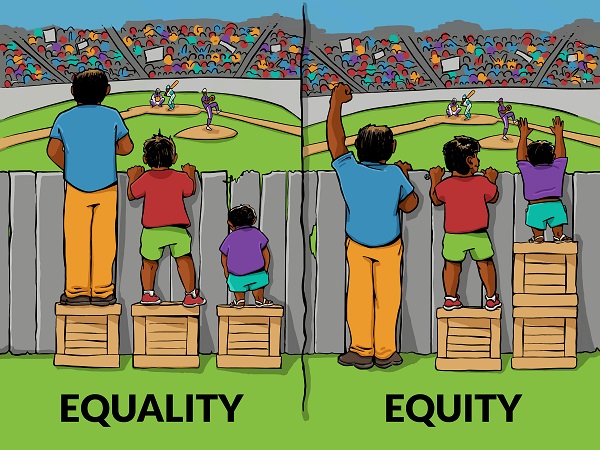
The vision inspires each of us to treat all persons fairly and share what we have. It also offers a critique of the economic systems by which our societies operate. We might argue that capitalism is the best we can do at the present time, but we still want to be moving toward the just society. Sadly, the growing separation of rich and poor that is taking place in the present financial capitalism is moving in the wrong direction.